
In commercial buildings across Nigeria and West Africa, vertical transportation efficiency directly impacts tenant satisfaction, productivity, and overall property value. At the heart of this efficiency is a critical metric: elevator waiting time.
Whether managing a high-rise in Lagos, a hospital in Accra, or a government facility in Lomé, understanding this metric is essential. Elevator waiting time is defined as the duration a passenger waits from the moment they press the hall call button until the elevator doors open at their floor. Industry standards generally recommend an average waiting time of 25 to 30 seconds during peak periods.
2. How Is Elevator Waiting Time Calculated?
Elevator waiting time is typically calculated using advanced traffic simulation software or mathematical formulas based on the Round Trip Time (RTT) of the elevator system. The core calculation considers:
- Door operating time: The time taken for doors to open and close completely.
- Passenger transfer time: The time required for passengers to enter and exit (typically 1.2 to 1.5 seconds per person).
- Flight time: The time taken for the elevator to travel between floors at its rated speed.
- Acceleration and deceleration time: The time lost during starting and stopping at each floor.
By dividing the total round trip time by the number of stops, or by using advanced probabilistic models, facility managers can accurately estimate the average interval between elevator arrivals.
3. Waiting Time vs. Journey Time: What’s the Difference?
While often confused, these are two distinct metrics in vertical transportation:
- Waiting Time: The time spent in the lobby or hallway before the elevator arrives.
- Journey Time (Transit Time): The time spent inside the elevator traveling from the origin floor to the destination floor.
A comprehensive vertical transportation strategy must optimize both. A short waiting time is quickly negated if the journey time is excessively long due to too many intermediate stops.
4. Key Factors That Affect Elevator Waiting Time
Several dynamic variables influence how long passengers wait. Understanding these is the first step toward optimization.
- Passenger Volume: Higher volume directly increases waiting time. During morning "up-peak" periods (e.g., 8:00 AM to 9:30 AM in Lagos commercial hubs), a surge of employees can overwhelm the elevator bank.
- Elevator Quantity, Capacity, and Speed: More elevators reduce the interval between arrivals. Larger cabins accommodate more passengers per trip, and higher-rated speeds (e.g., 1.6 m/s or 2.5 m/s) decrease flight time, allowing the elevator to return to the lobby faster.
- Building Type and Occupancy Patterns: A hospital in Accra experiences different traffic patterns than a corporate tower in Abuja. Hospitals require consistent, 24/7 movement of staff and equipment, while corporate towers face intense, predictable morning and evening peaks.
- Peak Periods and Traffic Patterns: "Up-peak" (morning arrival), "down-peak" (evening departure), and "interfloor" (lunchtime transitions) each stress the system differently. Controllers must be programmed to prioritize lobby calls during up-peak and distribute cars evenly during interfloor traffic.
5. The Role of Elevator Traffic Analysis
Elevator traffic analysis uses historical data and simulation software to model passenger flow. By identifying bottlenecks, facility managers can adjust dispatching algorithms, zone elevators (e.g., low-rise vs. high-rise banks), or recommend physical upgrades. This data-driven approach transforms guesswork into precise, actionable improvements.
6. Common Causes of Excessive Waiting Times
- Inadequate number of elevators for the building’s total population.
- Outdated dispatching systems that cannot handle complex, modern traffic patterns.
- Frequent breakdowns or deferred maintenance causing reduced fleet availability.
- Poorly timed door operations or sluggish door motors.
- Misuse of elevators (e.g., using passenger lifts for heavy freight during peak hours).
7. Practical Ways to Improve Passenger Flow
- Implement Destination Control Systems (DCS): Groups passengers heading to the same floor into the same cabin, drastically reducing intermediate stops.
- Enforce Freight Policies: Restrict the use of passenger elevators for moving goods, furniture, or waste during peak hours.
- Stagger Work Hours: Coordinate with major tenants to slightly shift arrival times, flattening the morning peak.
- Optimize Door Settings: Adjust door dwell times to balance safety with swift boarding and alighting.
8. When to Consider Elevator Modernization
If traffic analysis reveals that the existing hardware is the bottleneck, modernization is the most effective solution. Upgrading the elevator controller, installing Variable-Voltage Variable-Frequency (VVVF) drives for smoother and faster acceleration, or modernizing door operators can dramatically reduce round trip time without the massive expense of replacing the entire shaft infrastructure.
9. The Value of a Professional Elevator Assessment
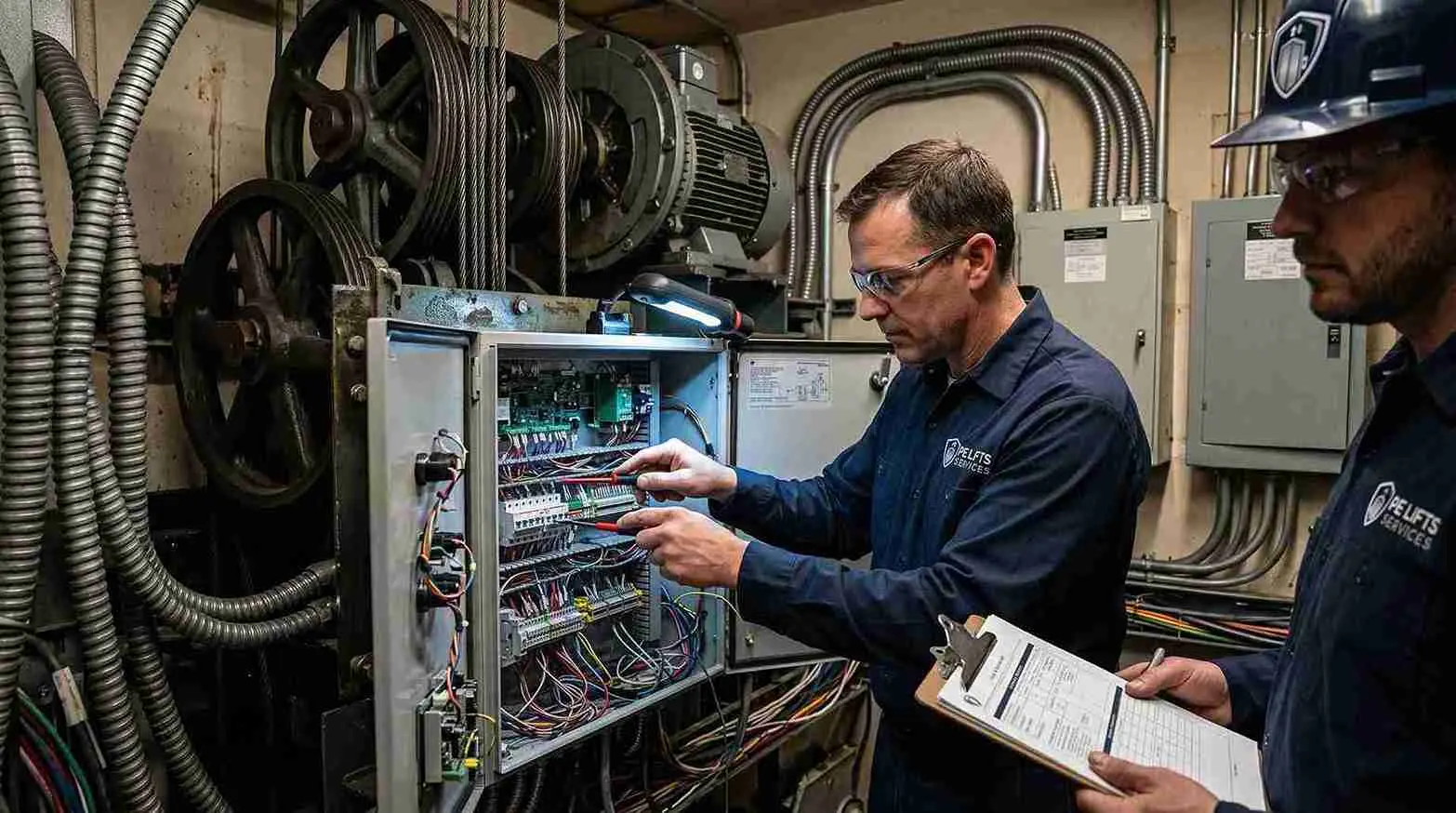
A technical audit by certified engineers evaluates the current state of the elevator system. It measures actual versus designed performance, checks safety compliance, and identifies worn components (like door motors or relays) that cause micro-delays. This assessment provides a clear, prioritized roadmap for corrective maintenance or modernization.
10. How PE Lifts Services Optimizes Your Vertical Transportation
As the dedicated maintenance and technical support division of PE Lifts Group, PE Lifts Services brings over 15 years of expertise to commercial and institutional facilities across Nigeria, Ghana, and Togo. We help building owners optimize vertical transportation through:
- Technical Audits: Comprehensive inspections to identify performance gaps and safety risks.
- Annual Maintenance Contracts (AMC): Structured preventive maintenance to ensure optimal, reliable operation and minimize unexpected breakdowns.
- Modernization: Upgrading controllers, door systems, and safety features to improve speed, efficiency, and passenger comfort.
- 24/7 Emergency Support: Rapid response (within 2 hours in major cities like Lagos, Abuja, Accra, and Lomé) to resolve breakdowns and restore passenger flow immediately.
Our factory-trained technicians service all major brands, including OTIS, KONE, Schindler, TK Elevator, and Mitsubishi, ensuring your building meets international safety and performance standards.
11. Comparison Table: Factors That Increase vs. Reduce Elevator Waiting Time
| Factor | Increases Waiting Time ❌ | Reduces Waiting Time ✅ |
|---|---|---|
| Elevator Quantity | Too few elevators for building occupancy | Adequate or strategically zoned elevator banks |
| Dispatching System | Outdated, basic collective-down logic only | Advanced Destination Control System (DCS) |
| Maintenance Status | Deferred maintenance, frequent minor faults | Structured Annual Maintenance Contract (AMC) |
| Passenger Behavior | Freight moved during peak passenger hours | Dedicated freight lifts and staggered work hours |
| Hardware Condition | Slow door operators, outdated controllers | Modernized VVVF drives and fast door motors |
12. Chart Data: Factors That Influence Elevator Waiting Time
(Note for Editor: In Microsoft Word, go to Insert > Chart > Clustered Column, and paste the following data to generate a professional, editable bar chart.)
Chart Title: Relative Impact of Factors on Elevator Waiting Time (Illustrative)
Y-Axis: Relative Impact Score (0–100)
X-Axis Categories & Values:
- Passenger Volume: 85
- Elevator Speed: 70
- Dispatching Logic: 65
- Door Operation Time: 50
- Maintenance Frequency: 45
13. Frequently Asked Questions (FAQs)
1. What is the acceptable elevator waiting time in commercial buildings?
Industry standards recommend an average waiting time of 25 to 30 seconds during peak periods for commercial buildings. Exceeding 35 seconds often leads to tenant dissatisfaction and perceived inefficiency.
2. How can I reduce elevator waiting time in my building?
You can reduce waiting time by implementing a Destination Control System (DCS), enforcing strict freight policies during peak hours, staggering tenant work hours, and ensuring regular preventive maintenance.
3. What is the difference between elevator waiting time and journey time?
Waiting time is the duration a passenger waits in the lobby for the elevator to arrive. Journey time is the duration spent inside the elevator traveling from the origin floor to the destination floor.
4. How does elevator traffic analysis improve building efficiency?
Traffic analysis uses data modeling to identify bottlenecks in passenger flow. It helps facility managers optimize dispatching algorithms, zone elevators effectively, and plan targeted, cost-effective modernizations.
5. When should a building owner consider elevator modernization?
Modernization should be considered when the building experiences persistent long waiting times, frequent breakdowns, or when the elevator system is over 15–20 years old and no longer meets current traffic demands or safety codes.
6. Does PE Lifts Services provide elevator maintenance outside of Nigeria?
Yes. PE Lifts Services provides comprehensive elevator maintenance, modernization, and technical support across West Africa, with active operational hubs in Nigeria, Ghana, and Togo.
7. How quickly does PE Lifts Services respond to elevator breakdowns?
We guarantee a rapid response time of 2 hours for emergency calls in major cities (Lagos, Abuja, Accra, Lomé) and 4–6 hours for other locations, ensuring minimal disruption to your building’s operations.