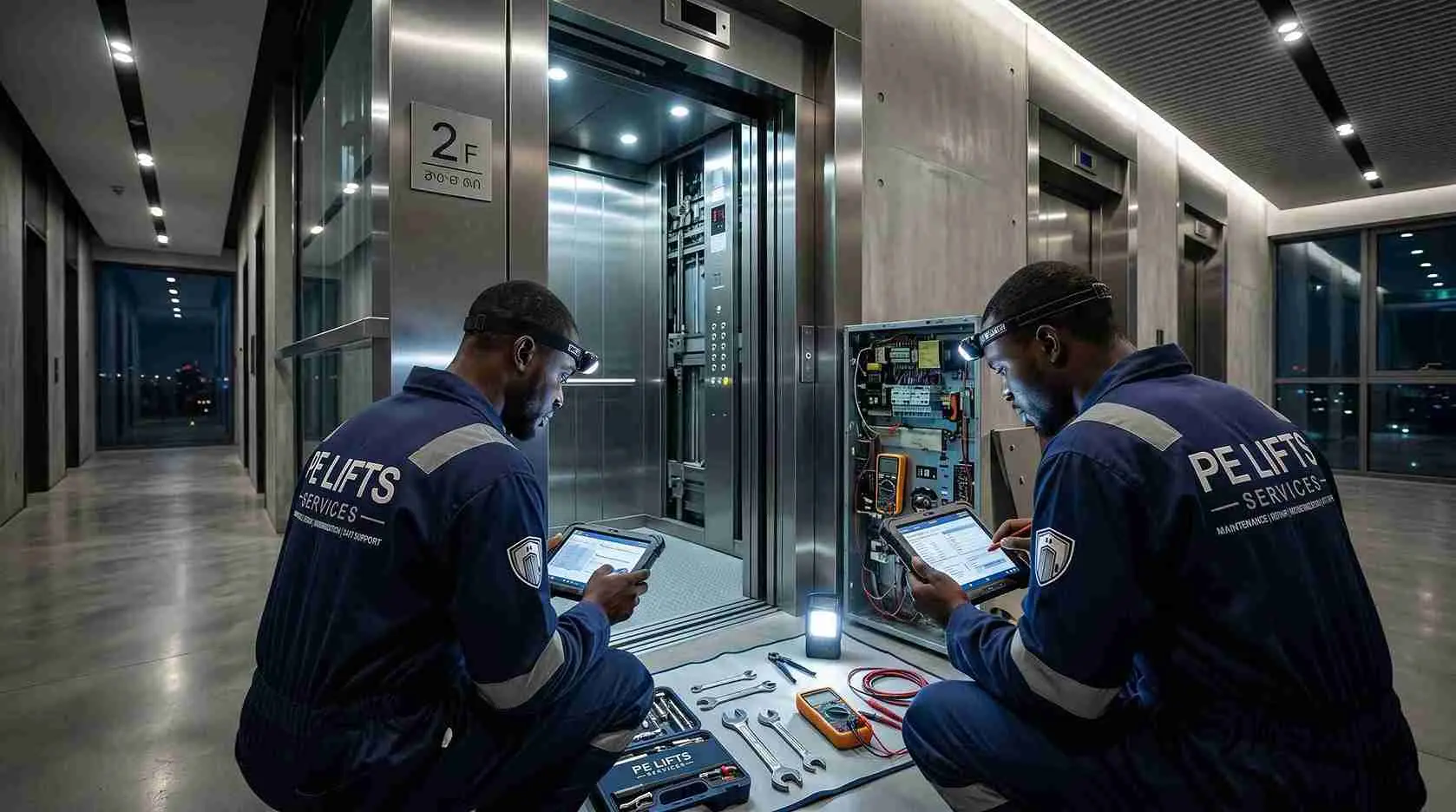

When an elevator begins to show signs of age, building owners and facility managers face a critical decision: should you modernize the existing system or replace it entirely? The answer is rarely black and white. Elevator modernization vs replacement is not just a question of cost; it is a strategic decision based on equipment condition, structural integrity, long-term operational needs, and budget constraints.
Modernization solves specific performance and reliability issues by upgrading key components while retaining the existing infrastructure. Full replacement involves removing the old system and installing a new one, often addressing broader structural or technological gaps. Choosing the right path requires a technical assessment rather than relying solely on the elevator’s age. At PE Lifts Services, we help Nigerian building owners navigate this complex choice with data-driven insights and professional engineering support.
What Is the Difference Between Elevator Modernization and Replacement?
Understanding the scope of each option is the first step in making an informed decision.
Elevator Modernization involves upgrading specific parts of an existing elevator system to improve performance, safety, and reliability. This may include replacing the controller, door operators, fixtures, or hoist motors while keeping the shaft, rails, and cab structure intact. It is ideal when the core infrastructure is sound but the technology is outdated.
Full Replacement means removing the entire elevator system, including the car, counterweight, rails, and machine room equipment, and installing a brand-new unit. This is necessary when the existing infrastructure is compromised, obsolete, or incompatible with modern safety standards.
The decision should never be based on age alone. A well-maintained 20-year-old elevator may only need targeted modernization, while a poorly maintained 10-year-old unit might require full replacement due to extensive wear.
What Factors Should Determine the Decision?
Several technical and operational factors influence whether modernization or replacement is the better choice.
- Equipment Condition: Are major components like the motor, gearbox, and controller still viable?
- Obsolescence: Are spare parts still available? Is the control system supported by the manufacturer?
- Safety Standards: Does the current system meet modern Nigerian and international safety codes?
- Building Usage: Has the building’s traffic pattern changed? Do you need higher capacity or speed?
- Structural Integrity: Is the shaft and pit in good condition?
- Budget: What is the available capital for immediate investment versus long-term savings?
- Downtime Tolerance: How much disruption can the building occupants tolerate?
Decision Factor Comparison
| Factor | Favors Modernization | Favors Replacement |
|---|---|---|
| Shaft Condition | Good, no structural issues | Damaged or non-compliant |
| Component Availability | Parts are accessible | Obsolete, hard to source |
| Control System | Upgradable | Fully obsolete, unsupported |
| Budget | Limited initial capital | Higher initial budget available |
| Long-Term Goal | Extend life by 10–15 years | Reset lifecycle for 20+ years |
Does the Condition of the Shaft Affect the Decision?
Yes, the condition of the shaft is a critical determinant. If the existing shaft, pit, and machine room are structurally sound and meet current dimensional requirements, modernization is often feasible. However, if the shaft has water damage, structural cracks, or does not accommodate modern equipment dimensions, replacement may be the only viable option.
A qualified technical assessment is required to evaluate the shaft’s integrity. PE Lifts Services conducts thorough inspections to determine if the existing infrastructure can support upgraded components or if a complete rebuild is necessary.
Which Option Costs Less Over 10 Years?
When comparing costs, it is essential to look at the Total Cost of Ownership (TCO), not just the initial project price.
- Initial Cost: Modernization is typically 30–50% less expensive than full replacement.
- Maintenance: Newer systems from replacement may have lower maintenance costs initially, but modernized systems with new controllers can also achieve significant savings.
- Energy Efficiency: Both options can improve energy use, but new replacement units often feature the latest regenerative drives and LED lighting.
- Repairs: An older, un-modernized system will likely incur higher emergency repair costs.
10-Year Cost Comparison Framework (Illustrative)
| Cost Component | Modernization | Full Replacement |
|---|---|---|
| Initial Investment | Lower | Higher |
| Annual Maintenance | Moderate (reduced after upgrade) | Low (new warranty period) |
| Emergency Repairs | Low (new components) | Very Low (new system) |
| Energy Consumption | Improved | Optimized (latest tech) |
| Residual Value | Moderate | High |
Note: These are relative comparisons. Actual costs depend on equipment type, building height, and usage. PE Lifts Services provides detailed quotations based on site-specific assessments.
Which Option Causes More Downtime?
Downtime is a major concern for hotels, hospitals, and commercial buildings.
- Modernization: Can often be done in phases. For example, the controller can be upgraded while the car remains in service, or work can be scheduled during low-traffic periods. Total downtime may range from 2–4 weeks depending on scope.
- Replacement: Requires the elevator to be out of service for the entire duration, which can take 6–12 weeks or more. This may require installing temporary construction elevators or managing significant occupant inconvenience.
Can Modernization Be Done in Phases?
Yes, phased modernization is possible in many cases. You might start with the controller and fixtures, then upgrade the door operators and motor later. This approach spreads the cost over time and minimizes disruption. However, compatibility between old and new components must be carefully managed. Not all systems are suitable for phasing, so a technical review is essential.
What Is the Simple Decision Checklist?
Use this checklist to guide your initial thinking:
Consider Modernization When:
- The shaft and structural elements are in good condition.
- Major components like the motor and rails are still usable.
- You want to improve performance without a full rebuild.
- Budget constraints favor a lower initial investment.
- Downtime must be minimized.
Consider Replacement When:
- The shaft or pit has structural damage.
- The existing system is extensively obsolete with no parts availability.
- The building’s usage has changed significantly (e.g., higher traffic).
- You want the latest technology and a full warranty.
- Long-term operational efficiency is the top priority.
Disclaimer: This checklist is a general guide. A professional assessment by PE Lifts Services is required for a definitive recommendation.
Elevator Modernization vs Replacement: Which Should You Choose?
| Situation | More Suitable Option | Why |
|---|---|---|
| Targeted component failures | Modernization | Fixes specific issues cost-effectively |
| Obsolete control system | Depends | If other parts are good, modernize controller |
| Poor shaft condition | Replacement | Infrastructure needs rebuilding |
| High energy bills | Modernization/Replacement | Both can improve efficiency; replacement offers latest tech |
| Frequent breakdowns | Assessment Needed | Could be maintenance issue or end-of-life |
Frequently Asked Questions
1. At what point does replacement become cheaper than modernization? Replacement becomes more cost-effective when the cost of modernization approaches 60–70% of a new installation, or when frequent repairs make ongoing maintenance unsustainable.
2. Can modernization be done in phases to reduce downtime? Yes, many modernization projects can be phased. This allows the elevator to remain partially operational or reduces the continuous shutdown period.
3. Is elevator modernization cheaper than replacement? Generally, yes. Modernization typically costs less upfront because it retains existing structural and mechanical components.
4. How long does elevator modernization usually last? A comprehensive modernization can extend the useful life of an elevator by 10–15 years, depending on maintenance and usage.
5. How long does elevator replacement take? Full replacement usually takes 6–12 weeks, depending on the complexity of the removal and installation process.
6. Does elevator age determine whether it should be replaced? No. Age is a factor, but condition, maintenance history, and technological relevance are more important. A well-maintained older elevator may only need modernization.
7. How do I compare modernization quotations with replacement quotations? Compare the scope of work, warranty terms, expected lifespan, energy efficiency, and total cost of ownership over 10 years, not just the initial price.
How PE Lifts Services Can Help
At PE Lifts Services, we provide expert assessments to help you choose between modernization and replacement. Our team evaluates your elevator’s condition, analyzes traffic patterns, and provides a clear, unbiased recommendation. We specialize in elevator modernization in Nigeria and can identify early signs your elevator needs modernization. Whether you need a targeted upgrade or a complete system overhaul, our engineers ensure minimal disruption and maximum reliability.
Weighing modernization against replacement? Request a PE Lifts modernization assessment. Contact us today to schedule a site visit.